
Insights · Localization
Translation or localization for your Japanese website: which do you actually need?
You had the site translated into Japanese. The pages are live, the grammar is fine, and nothing is happening. No inquiries, very little search traffic, and no obvious thing to point at. Most of what you will find on this question is a table of definitions, and a table of definitions will not tell you what to do next. This will: three questions that decide which one your situation needs, the five things translation reliably leaves behind in Japanese, and a checklist you can score your own pages against before you brief anyone.
The three questions that decide it
Translation moves meaning from one language to another. Localization adapts the whole page so that it can be found, read and acted on by someone in the target market. Whether you need the second one is not a matter of ambition or budget. It comes down to what the page has to do.
Ask three things about the page in front of you.
- Does it need to be found in Japanese search? Translation produces the sentences you already had, in Japanese. It does not produce pages built around the words Japanese buyers actually type.
- Does someone have to act on it? A form, an inquiry, a purchase, a download. The last few steps before an action are where localized sites most often lose the person after everything else went right.
- Does it have to carry credibility to a buyer who is comparing vendors? Comparison pages are read alongside three or four competitors, and the reader is looking for reasons to eliminate you.
If all three answers are no, translation is genuinely enough. If any of them is yes, translation is the first step of the job rather than the job.
When translation is genuinely enough
We would rather say this plainly than sell past it. There are pages where careful translation is the correct and complete answer.
- Documentation and support content for customers you already have. They found you, they bought, they need to understand a procedure. Accuracy matters here; discoverability does not.
- Press releases and investor material. These are read because someone already went looking for them, usually from a link.
- Legal and policy text, where the requirement is fidelity to the original and consistency with your other markets.
- A first pass to test interest before committing budget. English or lightly translated pages can tell you whether anyone in Japan is looking at all. They will not tell you what your conversion rate could be.
The distinction is not quality. A translated page can be excellent. It is scope: translation works on sentences, and the problems below are not in the sentences.
Five things translation leaves behind
1. The words buyers actually type
Japanese is written in four systems that coexist in ordinary text: kanji, hiragana, katakana and Latin script. The same product can be written several ways, and those variants are not stylistic. They are different queries, with different volumes, competition and intent.
This is not a subtlety only specialists notice. Ask a general-purpose AI assistant why translating a site into Japanese tends to underperform and it leads with the same point: "Standard translation often fails because Japanese search behavior involves four distinct writing systems (Kanji, Hiragana, Katakana, and Romaji)" (Google Gemini, temporary chat, English prompt, measured by us on 6 August 2026).
A translator produces one rendering of your English phrase. Which rendering, out of the several that exist, is the one with demand behind it is a research question, and it has to be answered before the text is written rather than after. If your Japanese pages were written by translating an English keyword list, they are aimed at terms nobody checked. Which search engines those queries run on, with device-level data, is covered in Japanese search engines: what the data actually shows. How that research differs from the English version is covered in Japanese keyword research: four assumptions that quietly break it.
2. Where the lines break
English breaks lines between words. Japanese has no spaces between words, so a line can break between almost any two characters, and the language relies on a set of prohibition rules to stop that producing nonsense.
Those rules are written down. The W3C's Requirements for Japanese Text Layout states the line-start rule directly:
"In principle, no line should begin with closing brackets (cl-02), hyphens (cl-03), dividing punctuation marks (cl-04), middle dots (cl-05), full stops (cl-06), commas (cl-07), iteration marks (cl-09), a prolonged sound mark (cl-10), small kana (cl-11) or warichu closing brackets (cl-29) (line-start prohibition rule). Otherwise the line would have an odd appearance."
W3C, Requirements for Japanese Text Layout, section 3.1.7, confirmed 11 August 2026
The same document notes the opposite constraint for Western text: "A sequence of Western characters in a Western word should not be broken across a line-break, except where hyphenation is allowed." The two languages start from different assumptions about where a line is allowed to end, and a layout built for one does not satisfy the other by default.
In practice this shows up on phones, in headings and in buttons: a stray punctuation mark alone at the start of a line, a heading that splits a compound down the middle. None of it is a translation error. Every instance of it is visible to a Japanese reader in the first second.
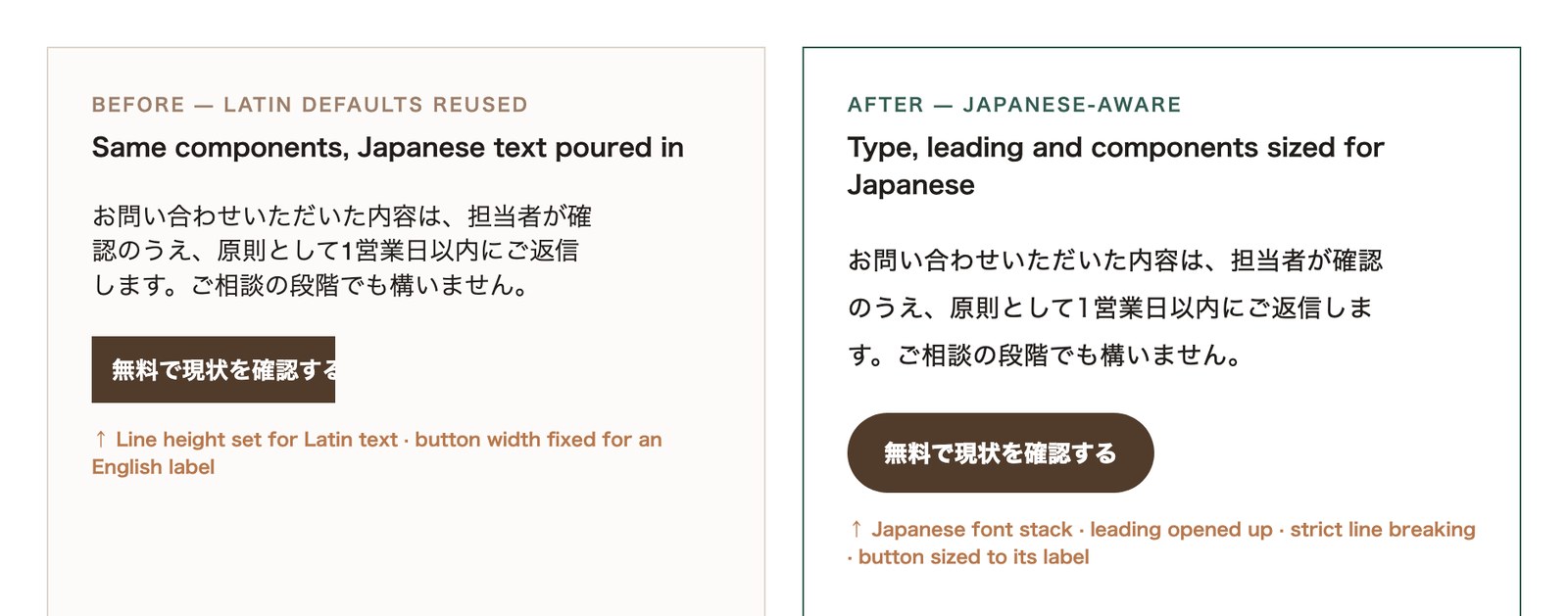
The clipped button on the left is worth sitting with, because it is not a typography problem at all. It is a component built to fit an English label, which is the same failure that shows up in the form fields later on this page.
3. Which register the site speaks in
Japanese carries politeness in the verb endings, and a site has to pick one setting and hold it. Mixed register reads as several people writing without an editor, which is exactly the impression a page being compared with competitors cannot afford. Translation done page by page, by different people or at different times, drifts. Nothing in the source text tells the translator which setting the rest of the site is using.
4. The blocks a Japanese buyer looks for
Japanese B2B sites tend to publish company details, delivery and support terms, and what happens after an inquiry, more explicitly than their overseas counterparts do. A page that omits them is not breaking a rule. It is missing the things the reader was scanning for, while the pages next to it in the results have them.
This is a content requirement rather than a translation one. There is nothing in your English site to translate, because the block does not exist there. How much weight it carries varies by industry, deal size, and whether the buyer is B2B or B2C, so it is worth checking against your own Japanese search results rather than taking it as a rule about the country.
5. The last metre
Forms are where localized sites lose the inquiry after everything else went right. Field expectations, what counts as a required field, whether there is a confirmation step before submission, what the error messages say, what the page after submission promises about a reply. Each of these is a small thing. Together they are the only part of the site that produces revenue.
A translated form is a form whose labels are in Japanese. Whether a Japanese person can complete it is a separate question, and the only way to answer it is to have one do so.
Two technical points worth checking today
These are cheap to verify and are frequently wrong on sites that were translated with a plugin.
Each language version needs its own URL, and users should not be moved between them automatically. The annotation that declares those versions to Google is hreflang. Google's guidance is explicit: "Avoid automatically redirecting users from one language version of a site to a different language version of a site. For example, don't redirect based on what you think the user's language may be. These redirections could prevent users (and search engines) from viewing all the versions of your site." (Google Search Central, Managing multi-regional and multilingual sites, confirmed 11 August 2026.)
Translating the shell but not the content creates its own problem. From the same document: "Translating only the boilerplate text of your pages while keeping the bulk of your content in a single language ... can create a bad user experience if the same content appears multiple times in search results with various boilerplate languages."
If your Japanese site has one URL that changes language by visitor IP, or a Japanese menu wrapped around English body copy, those are fixable this week and worth fixing before anything larger is commissioned.
Score your own pages
Run this against the Japanese pages you already have. The weights reflect what tends to decide whether a page produces inquiries, not what is hardest to build.
| Weight | Check |
|---|---|
| 3 | The Japanese pages target queries that were researched in Japanese, not translated from an English keyword list |
| 3 | Someone who reads Japanese has completed your Japanese form end to end, including the confirmation and thank-you steps |
| 2 | Company information, terms and what happens after an inquiry are present on the Japanese side |
| 2 | Line breaking has been checked at phone width, on headings and buttons as well as body text |
| 2 | One politeness register is used consistently across the whole site |
| 1 | Each language version has its own URL and visitors are not redirected automatically |
| 1 | The translated part is not only the navigation and footer |
| 1 | A Japanese reader has read the final pages, after they were built, in the browser |
How to read your score, out of 15. Twelve to fifteen: translation is not your bottleneck, so look at demand and at what ranks for your queries instead. Six to eleven: partially localized, and the gaps are specific, with the two three-point rows almost always holding the missing inquiries. Zero to five: the site is translated rather than localized, and adding more translated pages will not change the outcome.
If you would rather have this scored for you against your actual pages and your actual Japanese search results, that is what our fixed-scope written review covers.
What to ask before you brief anyone
Whoever you hire, these questions separate translation scope from localization scope early, while it is still cheap to change.
- Who decides which Japanese words the pages target, and when? If the answer arrives after the copy is written, you are buying translation.
- Will you show me the Japanese search results you are working from? Localization decisions should be traceable to something you can look at.
- Who reads the finished pages in a browser, in Japanese, before launch? Reviewing a document is not the same as reviewing the rendered page.
- Will a Japanese speaker submit the form? Ask for the date it was done and what happened.
- What is out of scope? A clear no is worth more than a broad yes.
- What do I own at the end? Files, access, and the research behind the decisions.
If a vendor cannot answer the first two, the price difference between translation and localization is not the thing to be comparing.
Where we sit
We do the localization side: Japanese keyword research, the pages built on it, the layout and register work, and the form path from first click to confirmation. We are not a general translation vendor, and for large volumes of documentation a specialist translation supplier will serve you better than we will. Most of our work runs in writing. An introductory call is not required at any stage, and online meetings can be arranged when a project needs them.
One thing worth knowing, because it affects how you search: when we tested how AI assistants answer questions about finding this kind of help in Japan, the candidates returned for written assessments that do not require a call were presented primarily in Japanese, and the bilingual options that came up had a consultation built into onboarding (our own measurement, English prompts, temporary chats, 6 August 2026). If the shortlist you are building looks thin, that is a property of how these providers are indexed rather than a sign that you have missed something obvious.
What the localization work covers in detail is on Japanese website localization, and what we have and have not published about past work is on case studies.
FAQ
Frequently asked questions
Is localization the same as translation?
No. Translation works on the sentences. Localization decides which pages should exist, which Japanese terms they target, how they are laid out, what credibility content they carry, and whether the form can be completed. Translation is one input to that.
Can we start with machine translation and improve it later?
Yes, for validating whether anyone in Japan is looking. It is a poor basis for measuring conversion, because you will be measuring the translation rather than the offer. If you do this, keep the pages out of your conversion reporting until they have been localized.
Does Google penalize translated pages?
Not for being translated. Google's spam policies treat automated transformation, including translation, as something that does not by itself add value when it is used to generate pages at scale. A translated page competes on the same terms as any other page: whether it is useful to the person who arrived on it.
How do we tell whether our current Japanese site is translated or localized?
Score it against the checklist above. The fastest single test is the first row: ask whoever built it which Japanese queries the pages target, and where those queries came from.
Do we need a separate Japanese domain?
Usually not. A subdirectory on your existing domain is the common arrangement and keeps the site's history working for you. What matters more is that each language version has its own URL and that visitors are not redirected between them automatically.
Do we need a call to get started?
No. Send the URL and where you are with Japan, and you will get a written reply with fit, an approach and a quote. That reply is free.
If you want the checklist scored for you
Send your Japanese pages, or the English ones you were planning to translate, and tell us what you want them to do. We will reply in writing with what we would treat as translation scope, what we would treat as localization scope, and what it would cost. That reply is free.