01 · A scoping reply
Initial fit and scope review
Free
Whether we can help, what we would do first, an outline of scope and deliverables, a timeline and a quote.

Localization · Bilingual sites · Japanese web design
A Japanese version of your site is not a translation of your site. It is a version built for what Japanese buyers search for, what they check before they contact a vendor, and how they expect to be answered.
SuzuLabo plans, writes and builds Japanese and bilingual websites for overseas B2B, SaaS, IT and professional-service companies. We are a Japanese company in Sapporo, and the same people who research Japanese search demand write the Japanese pages and set up the measurement afterwards.
Most of our work runs in writing. An introductory call is not required at any stage, and online meetings or additional language support can be arranged when a project needs them.
These three are often quoted as if they were the same purchase. They are not, and the cheapest correct answer is sometimes the first one.
| Option | What it changes | When it is enough | When it is not |
|---|---|---|---|
| Translation | The words | Documentation, support articles, legal text, internal material, and cases where the source content already matches what Japanese readers need | The page has to be found in Japanese search, or persuade a Japanese buyer to make contact |
| Localization | Words, structure, evidence, calls to action, layout and technical setup | You have a site that works and need it to work in Japan | The original structure was built around an offer, market or funnel that does not exist in Japan |
| A Japanese site of its own | The whole thing, planned from Japanese demand | The Japanese offer, buyer or sales process differs materially from the original | You only need a first foothold and a small number of pages |
We will tell you which of the three your situation calls for, in the free review, before you commit to anything. Recommending the largest option by default is how localization projects get expensive without getting effective.
If you would rather work it out yourself first, translation or localization for your Japanese website sets out the three questions that decide it, and a weighted checklist you can score your existing pages against.
Three ways to start
01 · A scoping reply
Free
Whether we can help, what we would do first, an outline of scope and deliverables, a timeline and a quote.
02 · A fixed-scope review
US$250 total
Japanese keyword hypotheses, examples from live Japanese search results and selected AI answers, a light technical and AI-crawler access check, localization and conversion findings, about 15 prioritized actions and a 30-day roadmap. Five business days, written delivery.
03 · The build itself
Quoted to scope
Priced per engagement from the pages, Japanese copy, design, front-end work, technical setup, revision rounds and timeline involved.
Included: a look at your public site and the Japan question you are asking, our view on fit, up to three clarifying questions, the approach we would recommend first, an outline of scope, deliverables and timeline, and a written quote.
Not included: keyword research with search volumes, analysis of Japanese search results or competitors, AI search testing, a crawl or technical audit, a prioritized fix list, a 30-day roadmap, or any implementation specification. That work is what the Snapshot and paid engagements are for.
If your question cannot be answered accurately without that research, we will say so and propose the Snapshot or a paid discovery step instead of guessing.
Which Japanese terms your buyers use, which of them have real search demand, what already ranks for them, and which pages should exist at all. Deciding this after the site is built is the most expensive sequence, because page structure determines what can rank later.
Japanese pages written for the intent behind the Japanese query. Where the English original carries a claim that does not travel, such as a US-specific proof point, a comparison to a vendor unknown in Japan, an offer structure that does not exist here, we replace it rather than translate it, and we tell you what we changed and why.
What belongs on the top page, how services are divided, what a Japanese buyer expects to find within one click, and which English pages should not be reproduced at all.
Japanese B2B sites generally publish company details, delivery and pricing terms, and clear contact expectations, and a page that omits them can read as incomplete to a buyer comparing vendors. How much of this you need varies by industry, deal size and whether you sell to businesses or consumers. We work from your actual Japanese search results rather than from a general theory about the market.
Form fields, labels, required-field handling, confirmation steps, error messages, privacy wording and stated reply times. On localized sites this is repeatedly where the loss happens: the traffic arrives, the form does not fit local expectations, and the inquiry never starts.
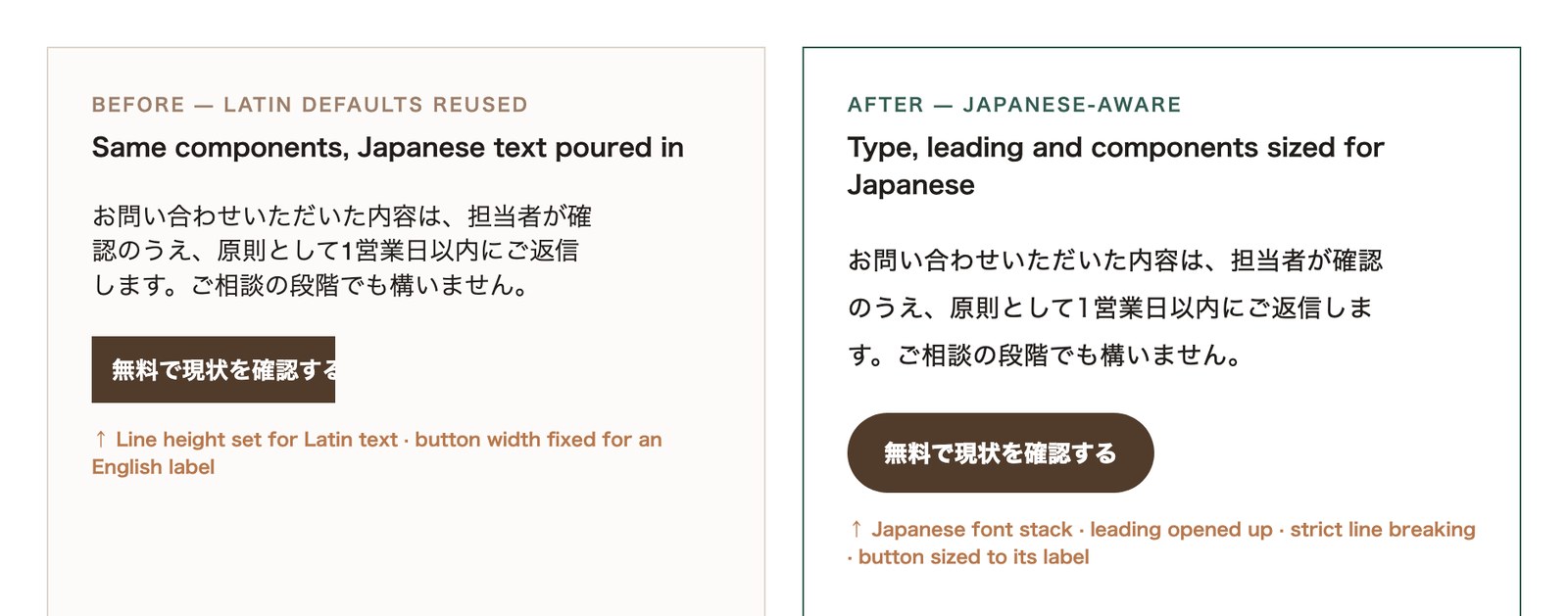
Japanese text has composition requirements that Latin-script layouts do not cover: line-breaking rules, character spacing, ruby annotation, mixed Japanese and Western text, and vertical writing where it applies. The W3C's Requirements for Japanese Text Layout documents these for implementation in CSS, SVG and XSL-FO, based mainly on the JIS X 4051 standard (W3C, confirmed 5 August 2026). In practice most of the work is unglamorous: font stack, line height, line-break behavior, heading rhythm, how a long Japanese sentence wraps inside your existing components, and it is what separates a Japanese page that reads as native from one that reads as a translation.
URL structure, language annotations, canonicals, sitemaps, the language switcher, and how the two versions coexist without competing. Details below.
Search Console by query, page, country and device; form starts and submissions; and the path from a Japanese entry page to an inquiry. Set up during the build, not bolted on afterwards.
URL structure. Google documents three workable options with different trade-offs: country-specific domains (clear geotargeting, but expensive and limited to one country), subdomains (easy to set up and separate, though users may not recognize the targeting from the URL alone) and subdirectories such as example.com/jp/ (easy to set up and low maintenance, but harder to separate) (Google Search Central, confirmed 5 August 2026). For most companies making a first move into Japan, a subdirectory on the existing domain is the pragmatic choice. We will say so when it is, and say when it is not.
Server location. Google notes that server location "is often physically near your users and can be a signal about your site's intended audience," while adding that many sites use CDNs or host abroad, so it is not a definitive signal. We do not treat moving your hosting to Japan as a prerequisite. If measured performance for Japanese users is genuinely poor, caching, a CDN and image weight come first.
Language annotations. Alternate versions can be declared with HTML link tags, HTTP headers or an XML sitemap. Google states that while all three can be used at once, "there's no benefit in Search," and that pages must reference each other: "if two pages don't both point to each other, the tags will be ignored" (Google Search Central, confirmed 5 August 2026). We implement one method consistently, including self-referencing annotations and fully-qualified URLs, and add x-default where a language selector exists.
Automatic redirects. Google advises against automatically redirecting users from one language version to another, because it can prevent users and search engines from seeing all versions. A visible language switcher that remembers the choice is the safer pattern, and it is also the one that annoys returning visitors least.
Content parity. The Japanese and English versions do not have to be mirror images. They do have to be honest about the same company, the same services and the same terms, which also happens to be what keeps AI-generated summaries from describing you inconsistently.
The Japanese website design question usually arrives as an aesthetic one and turns out to be an information one.
What we work on:
We work with your existing design system where you have one. Redesigning a brand that already works is not the goal, and we will not propose a rebuild when the gap is in the copy, the structure or the form.
We are not a general translation vendor. Large multi-language volumes, translation-memory operations, certified or sworn translation and document workflows are better served by a localization service provider, and we will say so rather than take work we are not the right shape for. Where a project needs additional Japanese production or specialist input, we can help identify and coordinate it.
We do not give legal, tax, regulatory or company-formation advice, and a Japanese website is not a substitute for it. JETRO's Investing in Japan service is the appropriate public starting point for those questions.
We do not guarantee rankings, traffic or revenue.
Evidence
Our own site
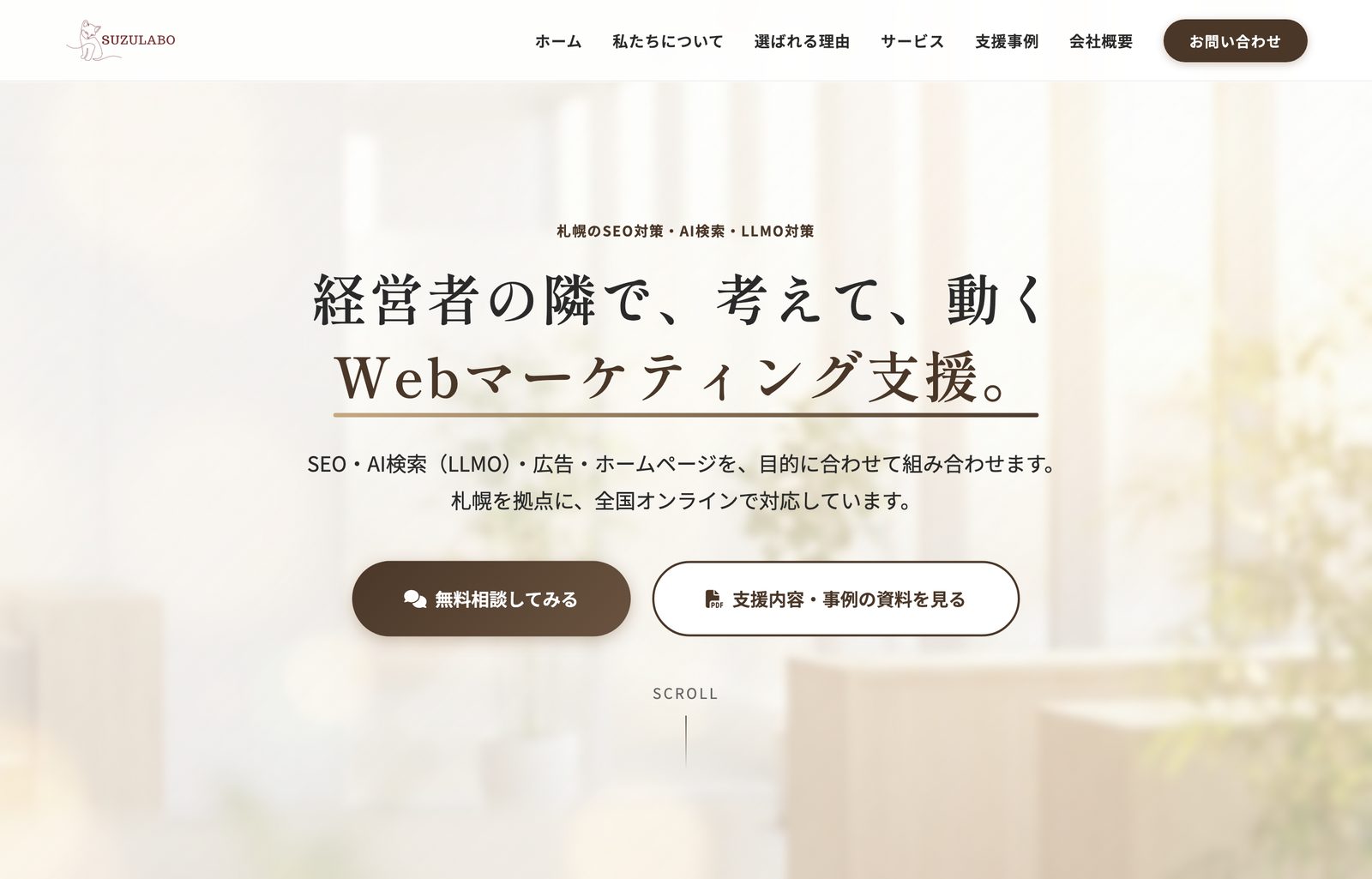
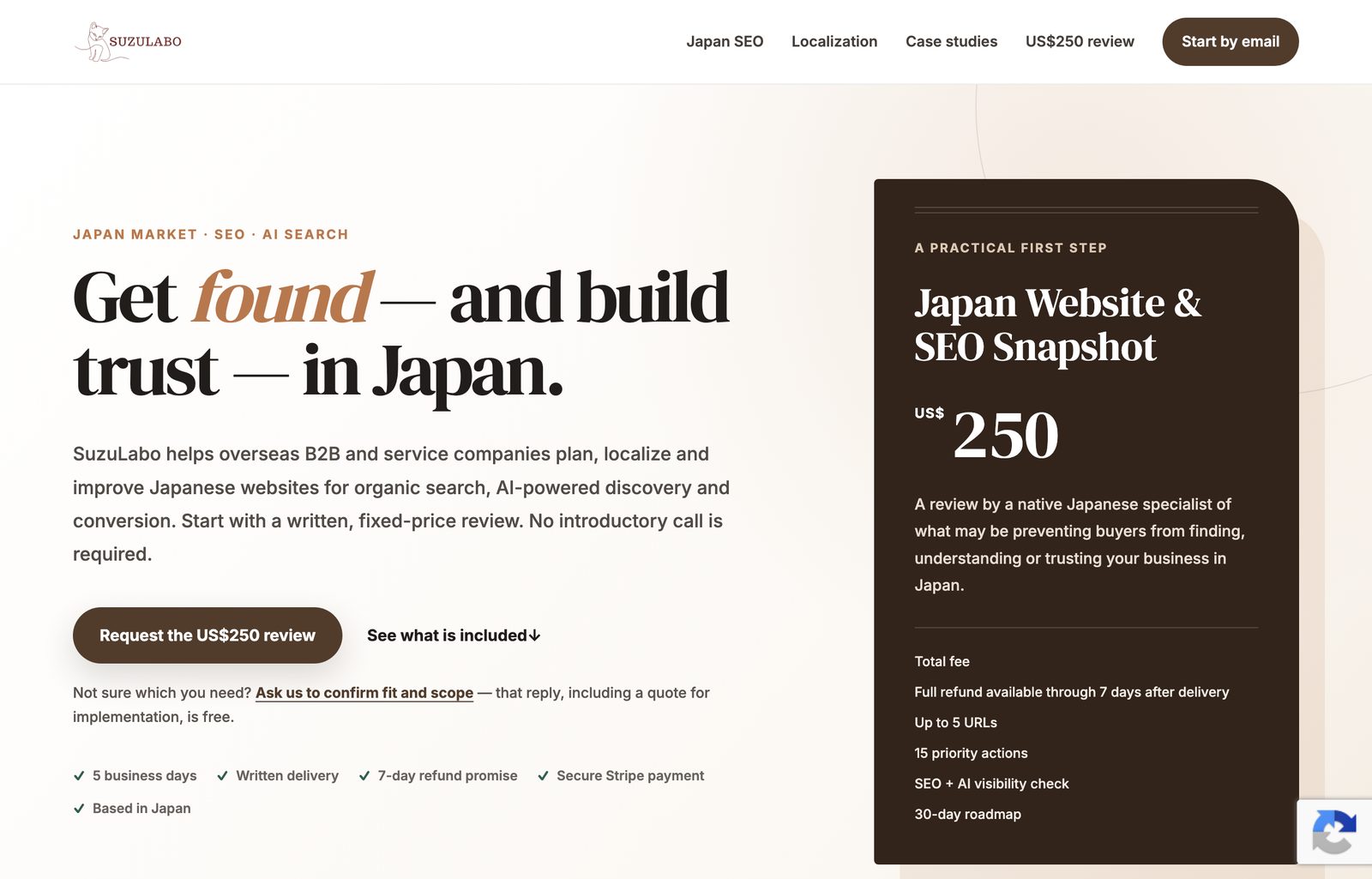
The Japanese site at suzulabo.co.jp and this English section are our own bilingual implementation: separate Japanese and English content, language annotations, structured company data and the inquiry form you can see on this site.
The one example we can show you in full, without asking anyone's permission.
Paid SEO content assignment
Keyword research, the article outline, a Japanese first draft and supporting image creation, published after Canva's editorial review. A third-party SEO tool estimates that the published URL peaked above 1,000 monthly organic visits in April 2026.
Third-party tool estimate, not Canva's own analytics. We do not claim our work alone caused it.
Japan-market SEO
Roughly 20 Japanese articles. As of July 2026, third-party SEO tool estimates showed the lead article ranking first for its main target topic, drawing an estimated 319 monthly visits, and appearing for 28 search queries.
A Japanese client in the Japanese market, not an overseas company entering Japan.
How the work runs
Your current site, whether a Japanese version exists, and what you need it to do.
Free, normally within one business day.
A scoped build, a single Japanese landing page, or the US$250 Snapshot if the priority is not yet clear.
Structure, copy and design decisions documented, with named review points at each stage.
Search Console, form starts and submissions, and the path from a Japanese entry page to an inquiry.
FAQ
Yes. Translation changes the words. Localization changes what the pages are, in what order, with what evidence and what next step, so that a Japanese buyer can find them in search and act on them. For some content, such as documentation, support articles and legal text, translation is genuinely enough, and we will tell you when that is the case.
Yes, and it is often the right first move. A single Japanese landing page built from real search demand, with a working form and measurement attached, tells you more than a full site built on assumptions.
Whichever fits. We work inside existing CMS platforms and design systems where they can carry Japanese content properly. We propose a rebuild only when the current structure genuinely blocks the Japanese version.
We do. Japanese pages are written for Japanese search intent by a Japanese specialist rather than routed to a translation vendor.
Usually not. A subdirectory on your existing domain is easy to set up and low maintenance, and Google states that server location is not a definitive signal since many sites use CDNs. If real-world performance for Japanese users is poor, we look at caching, CDN and image weight before hosting.
Not if the language annotations are set up correctly and both versions reference each other. Google's guidance is that alternate versions can be declared through HTML tags, HTTP headers or a sitemap, that using more than one gives no additional benefit, and that pages which do not point to each other will have their tags ignored. We implement one method consistently.
Yes. See Japan SEO services. The two are usually planned together, because the structure decided during a build determines what can rank afterwards.
No. Structure, copy and design review all run in writing. Online meetings and additional language support can be arranged for larger projects when they help.
Send your site and what you need it to do in Japan. We will tell you whether translation, localization or a Japanese site of its own is the right answer, what we would do first, and what it would cost. That reply is free.
Prefer email? kamada@suzulabo.co.jp