
Evidence · Measurement conditions · Limits
Case studies
We are a small Japanese company, and much of our work is done under agency contracts or as ghostwriting, which means we cannot publish it. Rather than fill this page with logos we have no right to use, here is what we can show, with the measurement conditions attached.
Three things worth reading first
- We separate first-party data from third-party estimates. SEO tool figures are estimates produced by a third party's model, not analytics from the client's own account. We label which is which every time.
- We do not claim causation we cannot demonstrate. A page that grew after we worked on it is not proof that our work caused the growth. Search results, competitors and the client's own activity all move at the same time.
- These are Japanese-market results. They show that we can execute Japanese SEO, content and web work. Where a client was a Japanese company rather than an overseas company entering Japan, we say so.
Case 01 · Japanese SEO content
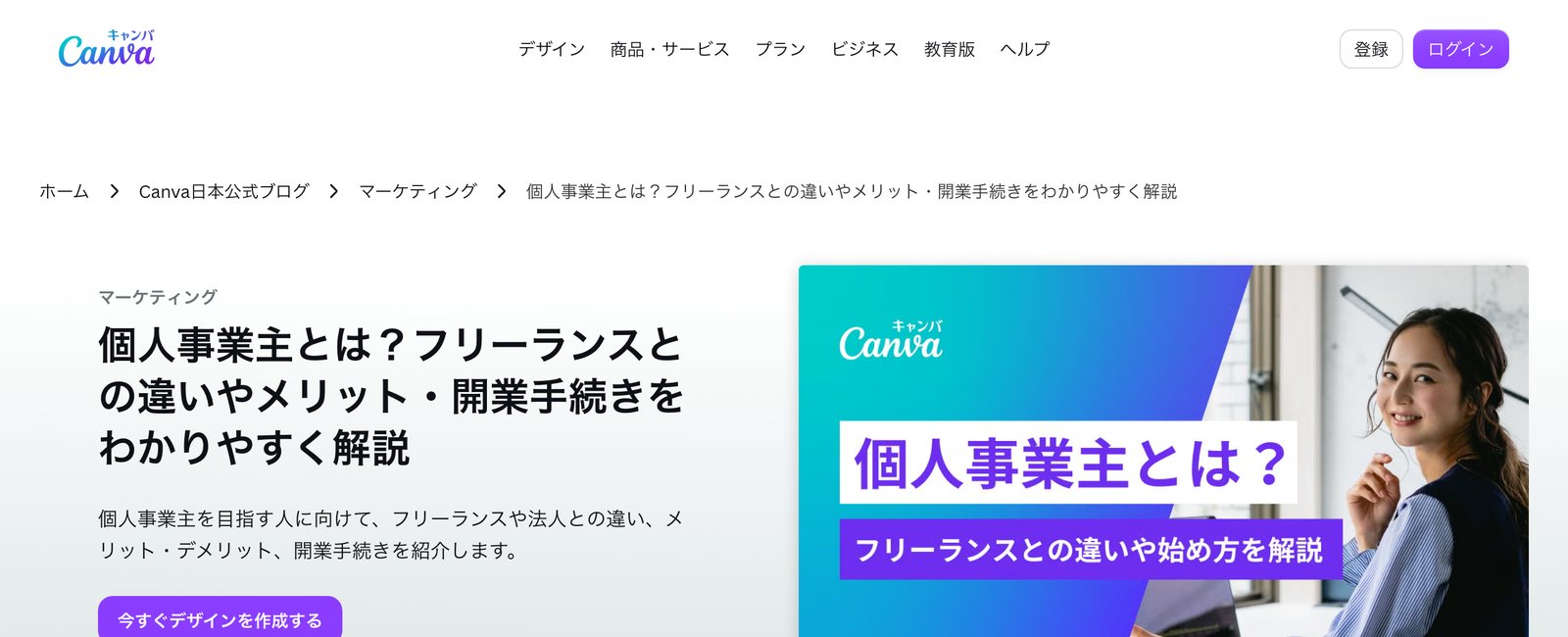
Canva Japan: paid SEO content for the official blog
| Client | Canva Japan |
|---|---|
| Work | Japanese SEO content production |
| Published | On Canva Japan's official blog |
| Status | Completed assignment |
What we did
SuzuLabo was engaged for a paid SEO content assignment for Canva Japan's official blog. Our scope covered the article production process:
- Japanese keyword research and topic selection
- The article outline, approved before writing
- The Japanese first draft
- Supporting image creation for the article
The final article was published after Canva's own editorial review.
What happened afterwards
A third-party SEO tool estimates that the published URL peaked above 1,000 monthly organic visits in April 2026, measured across September 2025 to August 2026.
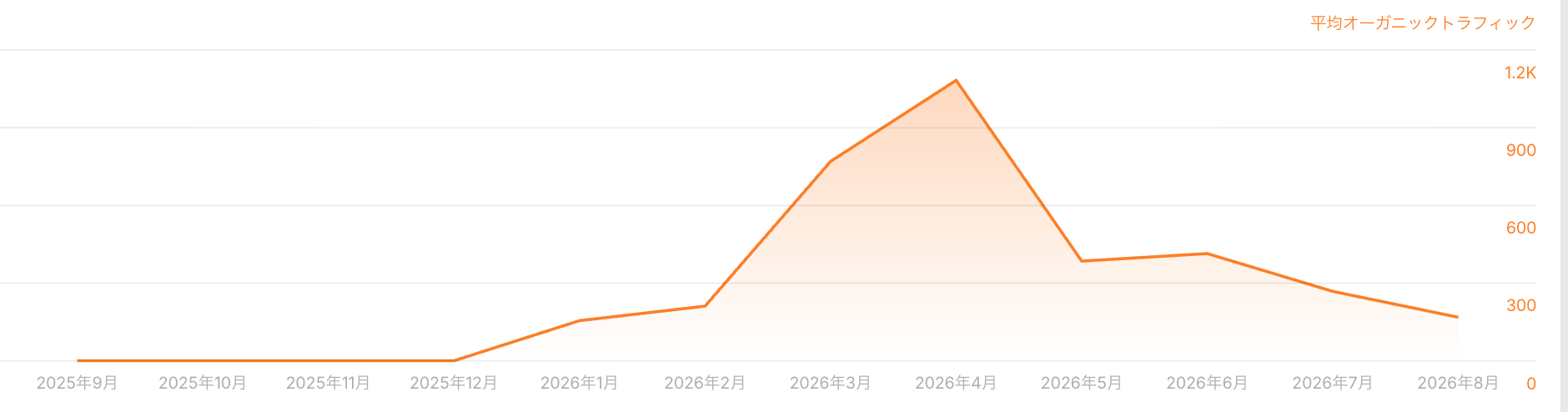
How to read that number. It is an estimate from a third-party SEO tool, not Canva's own analytics, and we do not have access to Canva's analytics. Canva's blog is a large, established property with its own authority, promotion and internal linking, and we contributed one article's production process within it. We are showing the outcome of an article we worked on, not claiming that our work alone produced the traffic.
Why we show it
Because it is verifiable. The article is public, the assignment was paid, and the scope above is what we actually did, not a longer version of it.
Case 02 · Japan-market SEO programme
Japan-market SEO for a Japanese B2B training provider
| Client | Name withheld |
|---|---|
| Market | Japan |
| Work | Japanese SEO strategy and article production |
| Programme size | Roughly 20 articles |
What we did
A Japanese-language SEO content programme for a B2B training provider: keyword and intent research, topic selection, article production and on-page work, run as a programme rather than as one-off articles.
Results
As of July 2026, third-party SEO tool estimates showed:
How to read those numbers. They are third-party SEO tool estimates as of July 2026, not the client's own analytics. Rankings and traffic move over time, and these figures will not be identical when you read this.
Why we show it, and what it does not prove
This was a Japanese company selling in Japan, not an overseas company entering Japan. It demonstrates that we can research, plan and produce Japanese SEO content that ranks. It is not evidence of a track record with overseas clients, and we would rather say that plainly than let an anonymized case imply something it does not support.
Case 03 · Our own work
Our own site, and our own measurement
The one project we can show you in full, without anyone's permission, is our own.
A bilingual site we built and run
suzulabo.co.jp is our Japanese site. The English section you are reading now is part of the same property: separate English content rather than machine translation, its own language annotations and canonical setup, structured company data, and a single inquiry form with English validation and confirmation handling.
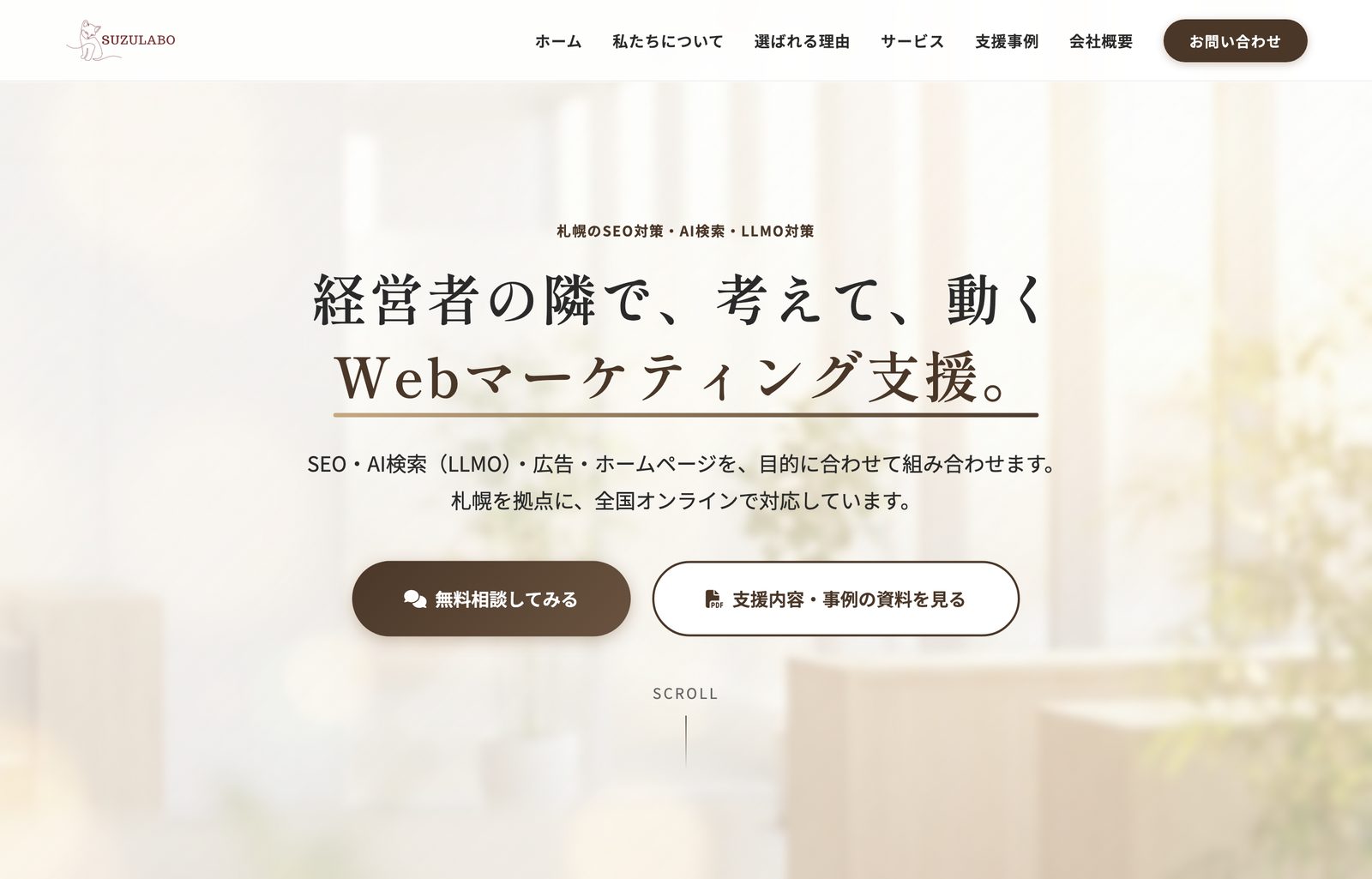
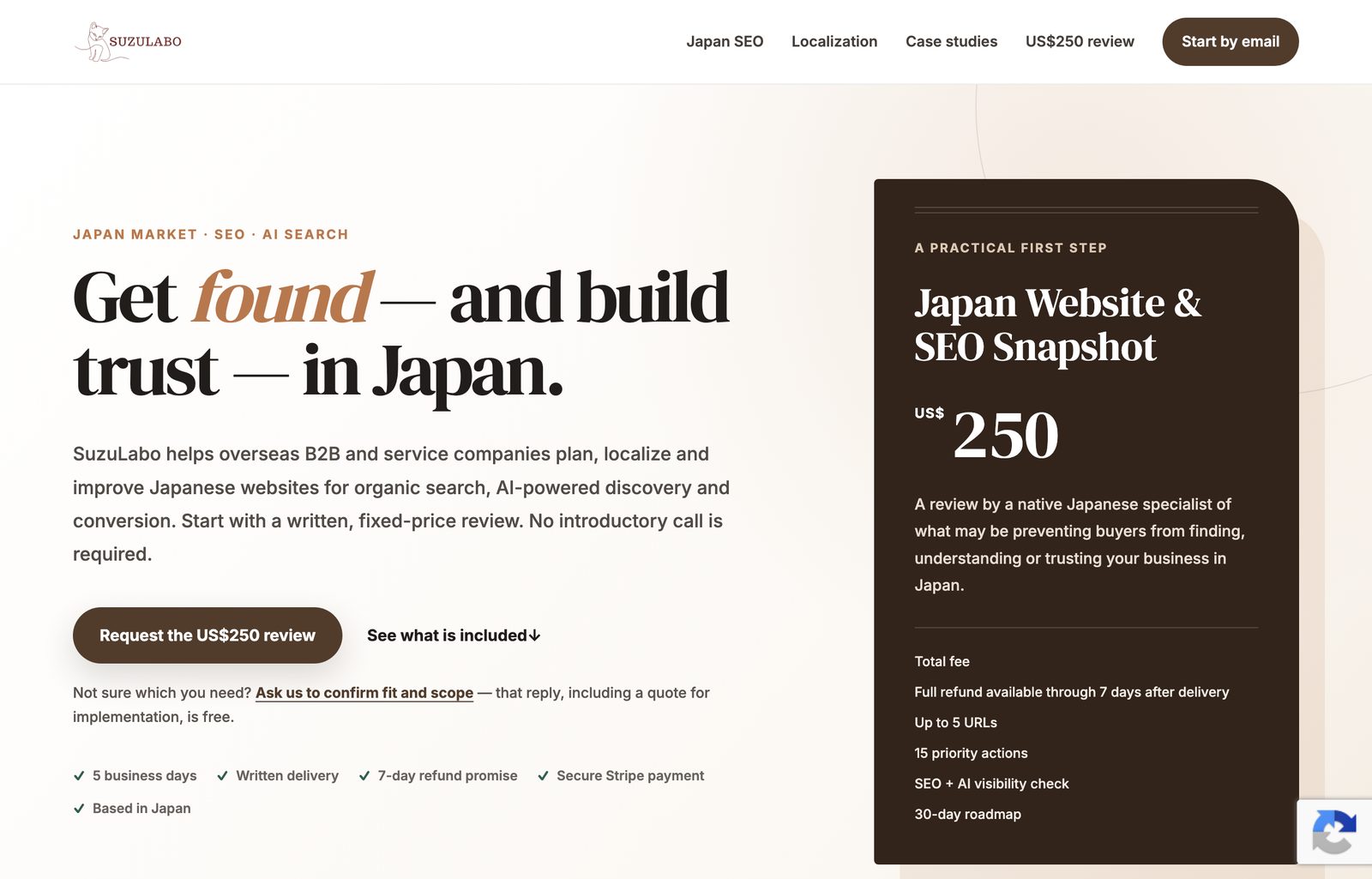
If you want to see how we treat Japanese typography, company information, form fields and the path from a page to an inquiry, the fastest review is to open both versions and compare them.
Measuring AI search visibility on ourselves first
Before we sell AI search visibility work, we run the measurement on our own brand.
Method. On 5 August 2026 we ran six purchase-decision questions across five AI systems (ChatGPT, Gemini, Perplexity, Claude and Microsoft Copilot) for 30 answers in total. The questions were asked in Japanese, in new or temporary conversations, with web search enabled, without personalization history. We saved the full text of every answer, the cited links, and a full-screen screenshot of each, and we counted the answers that did not mention us.
Baseline result. We were mentioned in 5 of 30 answers. Our official domain was cited in 4 of 30. Two of the five systems did not mention us at all.
What that is, and is not. It is a starting measurement of our own brand in Japanese, taken before the work, not a claim about what we can achieve for a client, and not a market study. Answers vary between systems, between phrasings of the same question and between runs, so a single measurement is a baseline to re-measure against, not a score. We run it on ourselves first because a vendor who has not measured their own starting position is not in a position to interpret yours.
Where this went next. We ran an English version three times, on 6 August, 16 August and 2 September 2026: eight fixed questions an overseas buyer would ask, on Perplexity, signed out and with no history. We were named in 1 of 8 answers on the first two dates and in 3 of 8 on 2 September, and one answer got a fact about us wrong. The method, the counts, the questions where we did not appear and the error are in what AI assistants say when asked for a Japan SEO vendor. (Counts measured by SuzuLabo on those dates from the saved answers.)
What we cannot show you yet
Being straightforward about this is part of the service.
- Agency and white-label work. A substantial share of our SEO and content work was produced under other companies' names. We cannot publish it, and we will not describe it in a way designed to let you guess.
- Work under NDA or without written permission. Where a client has not given written permission to be named or described, we do not publish the work, anonymized or otherwise. Removing a company name does not remove a confidentiality obligation.
- Bilingual website production. We have relevant production experience here too; it stays unpublished for the same confidentiality reasons.
If you need references before committing to a paid engagement, ask. We will tell you what we can arrange and what we cannot, rather than producing testimonials we cannot substantiate.
How we will report your project
The same rules apply to your work as to the cases above.
- We agree in advance what may be published: your name, your industry only, your metrics, screenshots, or nothing at all. These are separate permissions, and any of them can be declined without affecting the work.
- Reported figures carry their source, the measurement period, the metric definition and the date they were taken.
- We report what did not move alongside what did.
- Nothing is published as a case study without your written permission.
Start with a written review
Send your site and what you need to happen in Japan. We will tell you whether we can help, what we would do first, and what it would cost. That reply is free.
Services: Japan SEO · Japanese website localization