
Case 04 · Japanese SEO content · Published with a byline
Japanese SEO content for a global SaaS entering Japan: EngageLab by Aurora Mobile
Aurora Mobile is a NASDAQ-listed customer engagement company founded in China. Its Japan team in Tokyo publishes a Japanese-language blog for the EngageLab platform. In September 2026 that team briefed us, in Japanese, on one SEO article. We wrote it from their brief, in Japanese written for Japanese marketers; they edited and published it, and then asked to add our byline. Here is what that involved, and what it does not prove.
| Client | Aurora Mobile K.K. (Aurora Mobile株式会社), the Japanese entity of Aurora Mobile (NASDAQ: JG), for its EngageLab platform |
|---|---|
| Market | Japan, in Japanese |
| Work | One SEO article for the EngageLab Japanese blog, written in natural Japanese from the client's brief |
| Brief | Supplied by the client's Japan team, in Japanese (11 pages) |
| Published | 30 September 2026, after the client's own editing |
| Byline | Added by the client on 9 October 2026: name, reading, title, bio and photo |
Who the client is
Aurora Mobile (NASDAQ: JG) was founded in China in 2011 and began with push notification services for enterprises. Its Japanese business runs through Aurora Mobile K.K. in Tokyo, which publishes the Japanese site and blog for EngageLab.
EngageLab describes itself as an AI-first customer engagement platform. The product set covers app and web push, email, SMS, WhatsApp, marketing automation and authentication, sold as one platform that a company can adopt module by module.
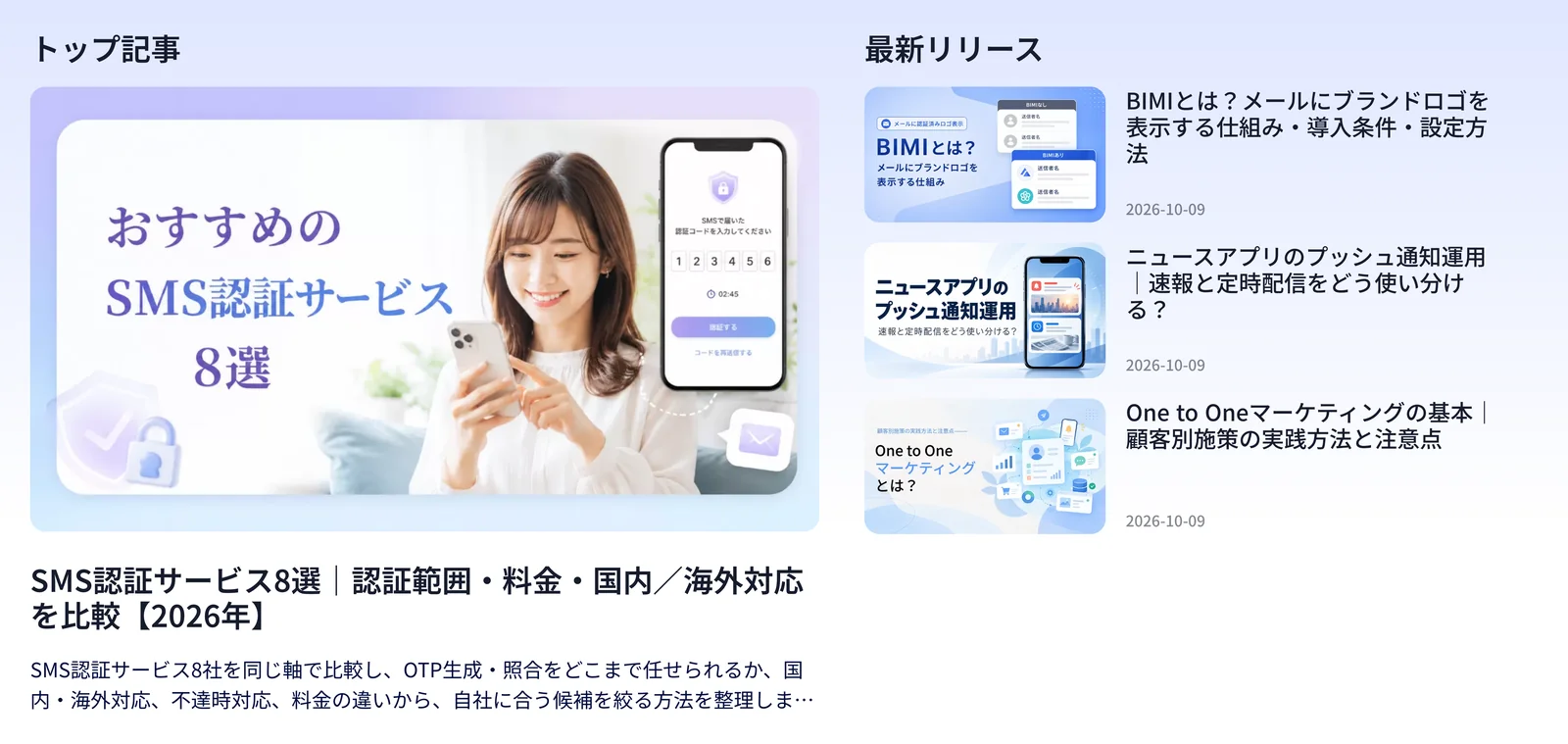
The Japanese site carries a blog for marketing teams alongside the product pages. The article in this case was written for that blog.

What they asked for
The request came in September 2026 from the person running EngageLab's Japan rollout: a writer who could produce Japanese SEO articles that Japanese readers would actually read. The themes on the table were B2B SaaS evaluation, email, SMS and WhatsApp delivery, and authentication and security.
Their working model was clear. The client would normally supply the article brief; in some cases they would want keyword research and topic selection included. We replied with our process in writing, one published article that carries our author byline as a sample, and a suggestion to start with a single article so that terminology and tone could be aligned to their standards before anything larger.
Why we send one published article, not a list. If your team does not read Japanese natively, a count of past articles tells you nothing about how the Japanese reads, and you cannot check a sample line by line yourself. One article published under our name on a third party's site gives you something you can act on: a Japanese colleague or customer can read it, and the fact that a publisher put our name next to it is a judgement you did not have to make alone.
How the work ran
Everything ran in writing. No call was needed at any stage.
| Date (2026) | Step |
|---|---|
| 16 September | Order placed for the first article |
| 18 September | Brief received: 11 pages covering the target keyword, the article's positioning, H2 and H3 headings, tables, link targets, Japanese style rules and expressions to avoid |
| 23 September | First draft delivered in Word, following the brief's headings |
| 24 September | Client confirmed the draft internally and accepted it as delivered |
| 30 September | Article published on the EngageLab Japanese blog with the client's own edits: illustrations, a customer example and product visuals were added, and some wording was adjusted |
| 8 to 9 October | Client proposed adding a byline; we supplied the name, title, bio and photo; the client shared the layout for approval and republished the article with the author block |
Dates are taken from our correspondence with the client and from the page's own published and modified dates (30 September and 9 October 2026), checked on 9 October 2026.
Top lane: the client. Bottom lane: SuzuLabo. The dashed link at step 6 is the profile we supplied for the byline the client proposed. Based on our correspondence and the page's published and modified dates.
The brief had a thesis, stated on its first page: one-to-one marketing itself is not outdated; what has aged is the way it used to be practised. That sentence set the editorial test for every section.
Four things we spent the time on
A detailed brief from head office fixes what the article must say. What it cannot fix is how the Japanese reads to a Japanese marketer: whether it sounds like a practitioner or like a translation. SEO craft, accurate facts and a readable structure are the entry ticket. The time went into these four things.
1. Write Japanese that reads like a practitioner advising a colleague, not a translation
The brief's own style rules asked for a professional, practical tone, written the way an experienced CRM or marketing operator would advise a colleague. We read that as the real deliverable: Japanese that a Japanese marketer would accept from a peer, with none of the phrasing that gives away a text translated from another language.
In practice that meant spreading the term variants (One to One, 1to1 and the katakana spelling) naturally rather than swapping them mechanically, addressing the reader as 自社 or 担当者 rather than あなた, keeping definitions short, and varying sentence endings. We counted the endings before delivery, because monotony is the first thing a Japanese reader notices.
2. Treat the brief's thesis as the editorial test, not a slogan
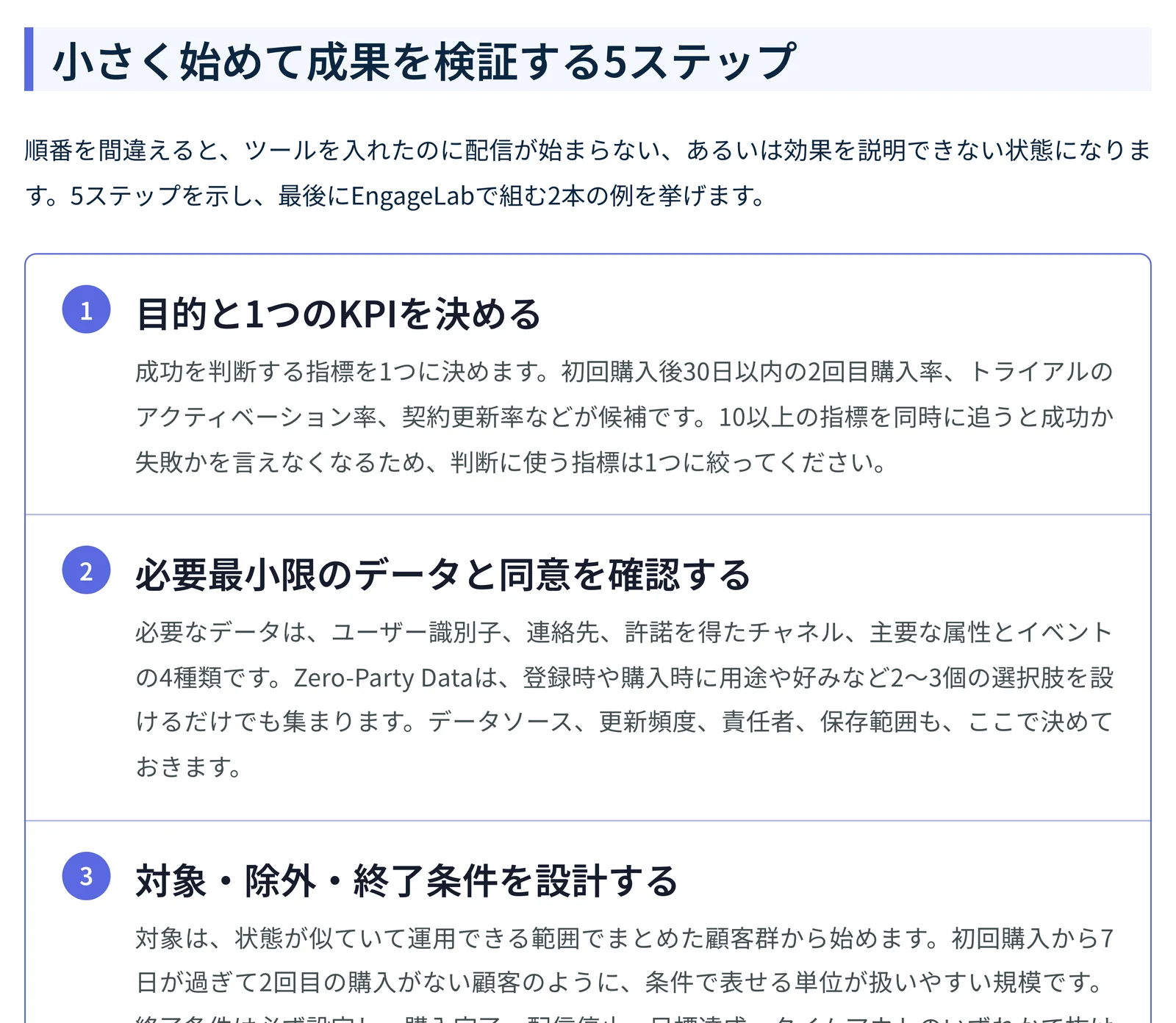
Each section contrasts the old practice with the conditions that make the approach work today. The goal we wrote towards was concrete: a reader should finish the article able to pick their first customer journey. The step-by-step section was given the most room for that reason.
The brief specified four tables. We added a fifth, a worked design for the first two journeys, showing the trigger, the message, the branch, the exit condition and the event to measure, on one page.
3. Check browser and consent facts against primary sources, with dates
Cookie and tracking claims age quickly, and Japanese search results are full of outdated versions of them. We checked the current positions on Google's Chrome blog and WebKit's own pages, and wrote the date of that check into the article text. The brief also asked for no unsupported absolute claims, which is the same discipline from the other side.
4. Keep the product positioned exactly as the client defines it
The brief defined EngageLab as the layer that designs customer journeys and executes delivery, and explicitly not as a customer data platform. We wrote to that definition and added nothing that would make the product sound larger than its role. A reader should be able to see where it fits in their own stack.
Before delivery, the draft was checked against the brief's requirements (headings, tables, links, notation) and then reviewed separately for sources and Japanese prose.
| Item | Fixed by the client's brief | Decided by SuzuLabo |
|---|---|---|
| Thesis | Answer the reader's doubt directly: the practice aged, not the concept | Contrast old practice with today's conditions in every section; aim for a reader who can pick a first journey |
| Headings | H2 and H3 structure, including headings that carry the katakana spelling | Kept the order; closed each section with a decision rule or a next action |
| Tables | Four: related concepts, suitable situations, old versus current practice, KPIs | Added a fifth: a worked design for the first two journeys |
| Links | Six internal links, one product page, two external sources | Checked every URL resolved and placed each where the argument needed it |
| Style rules | Paragraph length, how to address the reader, expressions to avoid | Wrote inside the rules; spread the term variants naturally, varied sentence endings and avoided unsupported absolutes |
| Facts | Date any claim about browser or platform behaviour | Verified browser positions against primary sources and wrote the check date into the text |
What the brief fixed, and what was left to our judgement. Brief received 18 September 2026; the specifics of the client's keyword data and prohibited-expression list are theirs and are not reproduced here.
What was published
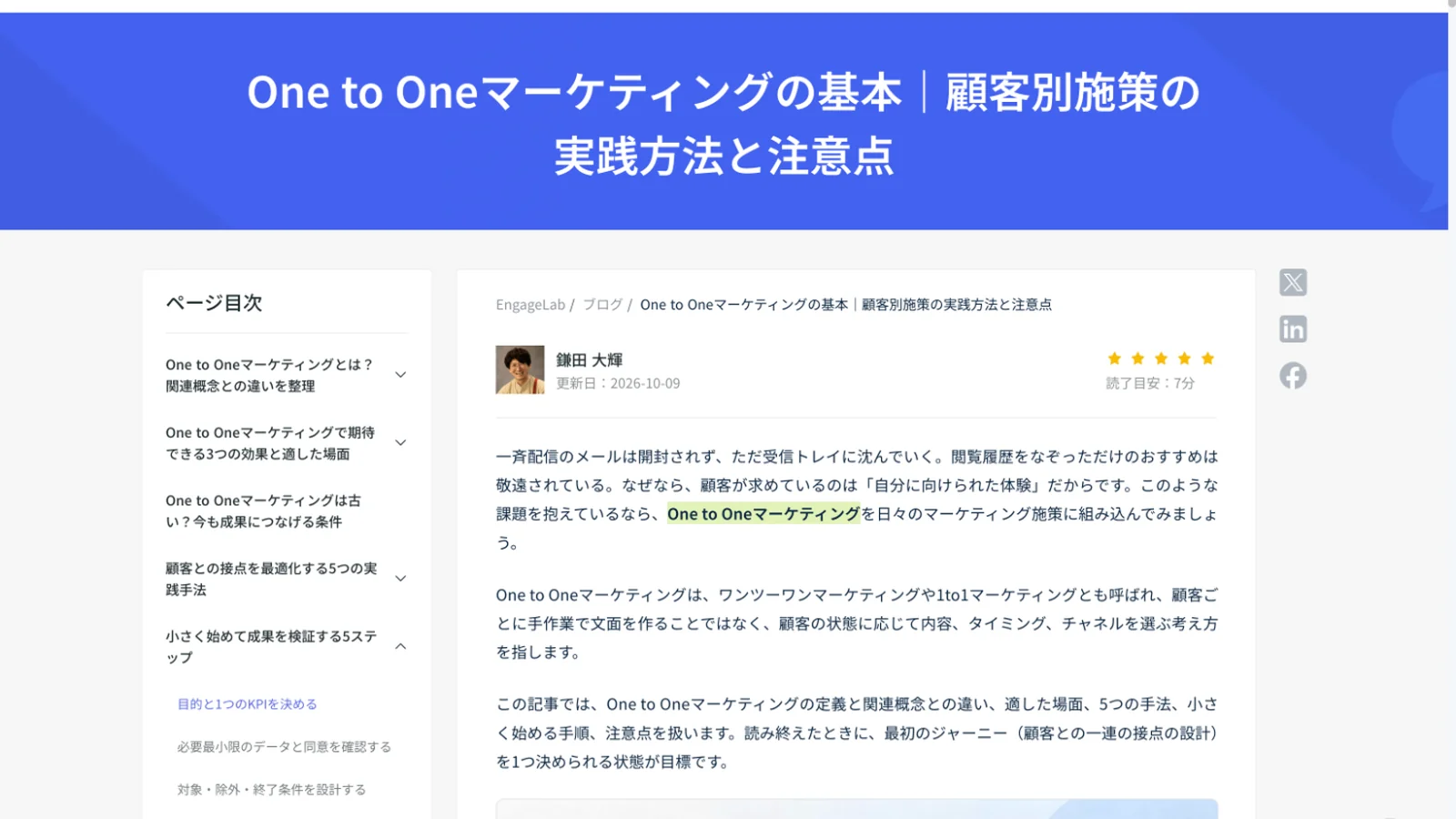
The article is live on the EngageLab Japanese blog. The published version is the client's: they added illustrations, a customer example and product visuals, and adjusted some wording. The text you read there is not identical to our draft, and we would rather say so than imply otherwise.
One to Oneマーケティングの基本|顧客別施策の実践方法と注意点 (EngageLab, in Japanese)
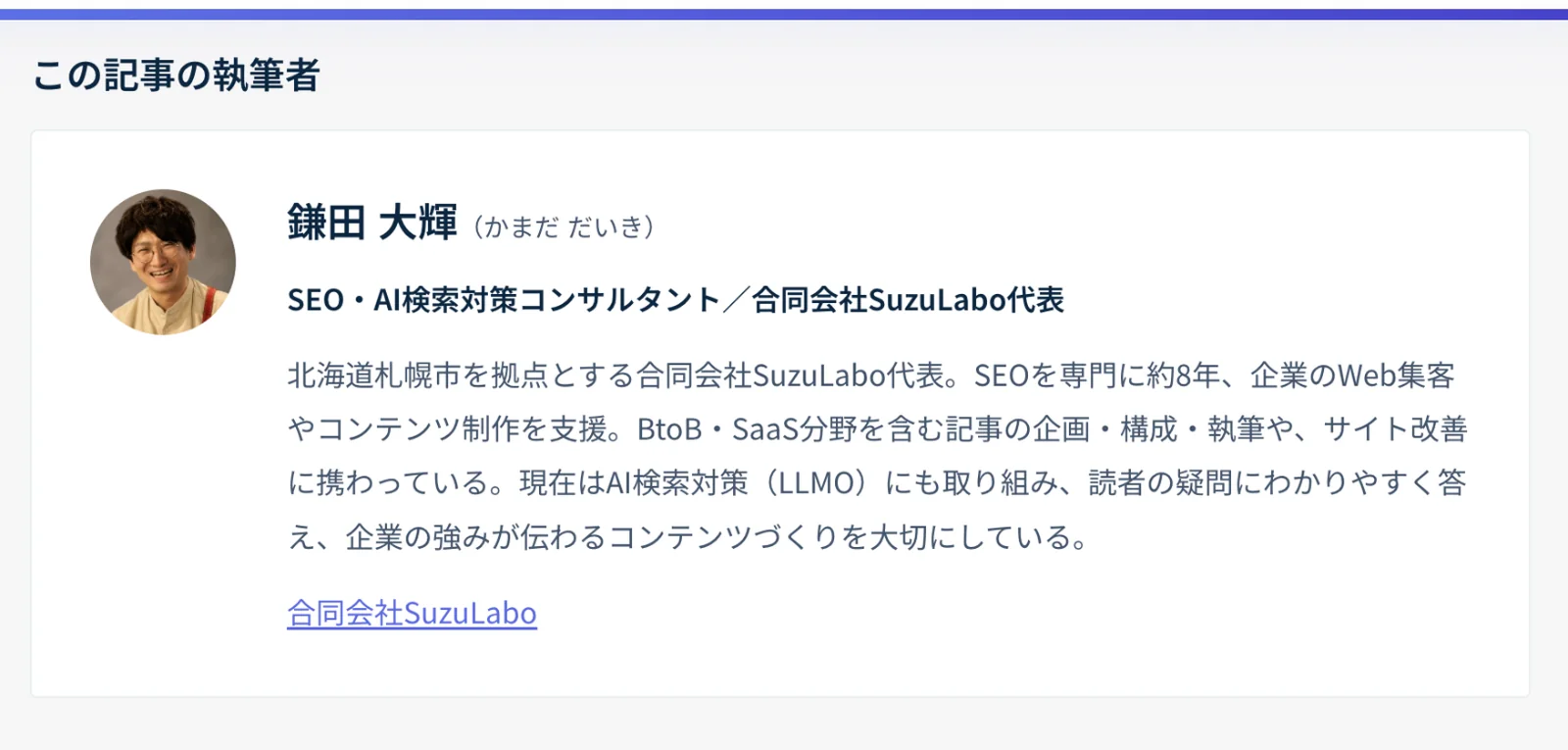

The byline was the client's idea. After publishing, they asked whether we wanted to be credited, requested the profile details, showed us the layout, and republished with the author block. A byline on a third party's site is the kind of evidence we prefer: it is public, it was placed by the publisher, and anyone can check it.
A note from Daiki Kamada, SuzuLabo. When I opened the published article, the first thing I noticed was that the team had added illustrations and made it easier to read. Whether to name the writer is the publisher's call. That they offered is, to me, the most useful outcome of this job: a reference I did not write myself. Good services from overseas often fail to reach the people searching in Japanese; this was one article's worth of help with that.
Why this matters if you are entering Japan
Natural Japanese is the deliverable, not a finishing touch. SEO knowledge, accurate facts and a readable structure are the minimum any writer should bring. What a non-Japanese team cannot check on its own is whether the article reads the way a Japanese CRM manager would write for a colleague, whether the terms are the ones Japanese buyers actually use, and whether anything still sounds translated. That is the part we take responsibility for, and the brief's own style rules asked for exactly that.
A Japanese brief from a global marketing team can be executed in Japanese, in writing. The client's team wrote the brief in Japanese, with their own positioning rules and prohibited expressions. We worked inside those rules and added judgement only where the brief left room. No meeting was required.
Fact-checking in Japanese is part of the writing, not a separate task. The terms Japanese readers search for, the misconceptions that circulate in Japanese, and the current state of an official source are things a non-Japanese team struggles to verify. We take that on and date the checks.
Credit that can be verified. Where a publisher chooses to credit the author, the credit sits on their site, not ours. It is a stronger reference than anything we could write about ourselves.
What this case does not prove
- No traffic or ranking figures. The article is days old, and we do not have access to the client's analytics. We publish numbers only with the source, the period and the metric definition, and there are none to publish yet.
- One article, not a programme. This was a single commissioned piece with a brief supplied by the client. It shows we can execute a Japanese brief to a global marketer's standard; it does not show the results of a sustained SEO programme.
- The client edited and published. The live version carries their edits and visuals. The scope we are claiming is the draft and the checks described above, nothing larger.
- Keyword research was not part of this piece. The client supplied the keyword and the positioning. On other engagements we do that research ourselves; here it was theirs.
How we would run this for you
If you have a brief, we write to it, in Japanese, and show you where we added judgement. Your positioning, terminology and prohibited expressions stay as you set them; our job is to make the Japanese read naturally to Japanese readers inside those rules. If you do not, we start with Japanese keyword research and an outline you approve before writing. Either way the work runs in writing, drafts come as Word or Google Docs files, and you decide what is published and whether we are credited.
Japanese SEO services · All case studies · Read this case in Japanese